Bikyingi Gorilla Family: Rushaga’s Habituation Experience Group in Bwindi.

The Bikyingi gorilla family lives in Rushaga, Bwindi, and is one of Uganda’s two Habituation Experience groups. See size, cost & how to book.

The Bikyingi gorilla family lives in the Rushaga sector of southern Bwindi Impenetrable National Park and is one of only two Ugandan gorilla groups alongside Bushaho in Nkuringo, gazetted for the four-hour Gorilla Habituation Experience rather than the standard one-hour trek. The group formed in early 2012 when several individuals broke away from the disintegrating Mishaya family and combined with wild, previously unhabituated gorillas. It carries the name of its dominant silverback, Bikyingi, also spelled Bikingi, who rangers describe as unusually patient with the group’s infants. A Habituation Experience permit for Bikyingi costs USD 1,500 per person, roughly double the standard USD 800 Uganda gorilla permit, and caps the group at four visitors rather than eight. This guide covers the family’s history, what a habituation morning with Bikyingi actually involves, how it compares to Rushaga’s other families, and the practical logistics of booking it into a Uganda gorilla safari.

Bikyingi Gorilla Family: Rushaga Sector Profile & Guide

Quick Facts: Bikyingi Gorilla Family

FactDetail
SectorRushaga, Southern Bwindi Impenetrable National Park
CountryUganda
FormedEarly 2012, breakaway from Mishaya plus wild gorillas
Named afterDominant silverback Bikyingi (also spelt Bikingi)
Reported group size15–21 individuals
Visit typeGorilla Habituation Experience
GHE permit priceUSD 1,500 per person
Standard permit price (Uganda, general)USD 800 per person
Visitors per day4 (Gorilla Habituation Experience) vs 8 (standard trek)
Time with the familyUp to 4 hours (GHE) vs. 1 hour (standard)
Other GHE-eligible familyBushaho, Nkuringo sector
Drive from Kigali to Rushaga~4–5 hours via Cyanika border crossing
Nearest airstripKisoro (~1–1.5 hrs drive to Rushaga)
🚊  Only ~128 Uganda gorilla permits issued daily

Your Gorilla Trek Starts With One Message

Tell us your dates and we’ll check live permit availability and send your quote within Minutes: free, no obligation.

Get My Free Quote   AUTO-registered operator · Budget to luxury · Uganda, Rwanda & Congo

Where the Bikyingi Family Lives: Rushaga Sector, Southern Bwindi.

Rushaga sits in the southern block of Bwindi Impenetrable National Park and holds more habituated gorilla families than any other of Bwindi’s four sectors; most current counts put it at nine to ten families, more than Buhoma, Ruhija, or Nkuringo. Bikyingi ranges through the forest close to the Uganda–DRC border, and this border-adjacent territory is one reason the family sees genuine day-to-day movement, which is relevant for anyone weighing the habituation experience against a standard trek elsewhere.

Getting to Rushaga

Most Trek Gorillas clients reach Rushaga overland from Kigali, a journey of roughly 4 to 5 hours via the Cyanika border post, the fastest and most affordable route into any of Bwindi’s southern sectors. Travellers starting from Entebbe instead face an 8- to 9-hour road transfer or can fly into the Kisoro airstrip in about 1 to 1.5 hours and drive the remaining short distance to Rushaga’s ranger post. In our experience, most first-time trekkers underestimate how much the choice of entry point (Kigali vs Entebbe) changes the shape of the whole itinerary, not just the drive time.

Terrain and altitude

Rushaga’s forest sits at a moderate elevation compared with Ruhija’s higher ridgelines, with rolling, densely forested hills rather than sheer ridge descents. Trails are frequently muddy and root-covered regardless of season, and because Bikyingi’s territory can extend toward the park boundary, habituation mornings sometimes involve a longer vehicle transfer to the trailhead before the hike even begins. Plan for a full day, not a half-day activity.

If a standard one-hour trek elsewhere in Rushaga is more your pace, our 3-Day Bwindi Gorilla Trekking Safari covers exactly that, with routing built around whichever family UWA assigns on the day.

How the Bikyingi Family Formed: The Mishaya Split of 2012

Bikyingi is a breakaway family, not an originally wild group that was habituated from scratch. In early 2012, a subset of gorillas separated from the Mishaya family itself, a breakaway from Nshongi, once Bwindi’s largest group, and combined with wild, previously unhabituated individuals already ranging in the same territory near a place locally known as Bikyingi. UWA rangers and researchers then began the multi-year process of getting this new, mixed group comfortable with a stationary human presence.

A brief timeline

  1. 2012: Individuals split from the disintegrating Mishaya group and merge with wild gorillas near Bikyingi; the habituation process begins under UWA supervision.
  2. 2012–2014: Rangers and researchers make daily, non-threatening visits over roughly two to three years, gradually reducing distance and increasing contact time, following the standard habituation timeline that UWA applies across Bwindi.
  3. 2014: Uganda’s Gorilla Habituation Experience program formally launches; Bikyingi is designated one of the two founding GHE families, alongside Bushaho.
  4. 2014–present: Bikyingi remains gazetted for the 4-hour habituation product rather than the standard 1-hour trek, with member counts fluctuating through births, deaths, and occasional transfers.

This scenario is a genuinely common pattern in Bwindi: silverback rivalry causes a family to fracture, and the resulting splinter group either merges with wild gorillas (as Bikyingi did) or strikes out alone. You can read more about how this process works generally in our guide to gorilla habituation.

Meet the Family: Bikyingi’s Structure and Members

Bikyingi Gorilla Family Silverback Male

The silverback Bikyingi

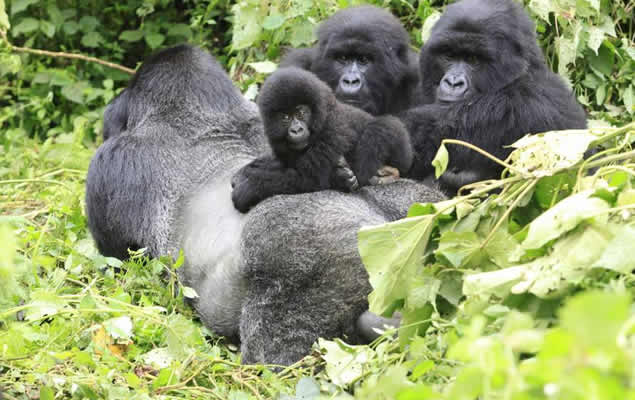
The group’s dominant silverback and namesake is consistently described by operators and rangers as unusually calm and gentle with the family’s infants, which is notable because infant tolerance varies widely between silverbacks and is one of the traits UWA trackers monitor closely during habituation.

Group composition

Published member counts for Bikyingi are inconsistent, which is itself worth knowing before you book. A composition often cited by regional operators lists roughly 15 members: 1 silverback, 5 adult females, 2 sub-adults, 2 juveniles, and 5 infants. More recent third-party listings put the total closer to 21, with a similar structure scaled up. The honest answer is that we cannot provide you a single verified figure that will still be accurate on your trek date, as group sizes change with every birth, death, and transfer, and semi-habituated groups like Bikyingi are surveyed less frequently than fully open trekking families.

Composition Element Lower Estimate Higher Estimate
Silverbacks 1 1
Adult females 5 9
Sub-adults 2 2
Juveniles 2
Infants 5 9
Total individuals ~15 ~21
Free Quote · A few Minutes Reply

Ready to See the Gorillas Yourself?

Tell us your dates and we’ll check live permit availability today: budget to luxury, Uganda, Rwanda & Congo.

Plan My Trek →

The Gorilla Habituation Experience with Bikyingi

This is the section that actually matters most for anyone researching Bikyingi specifically: almost everyone who treks this family does so through the Gorilla Habituation Experience, not a standard visit. GHE is Uganda’s exclusive offering; Rwanda’s Volcanoes National Park and DR Congo’s Virunga National Park have no equivalent product, and it puts you alongside the same researchers and trackers who are actively acclimating the family to human presence, rather than simply observing a fully settled group.

A Gorilla Habituation Experience: Morning with Bikyingi, hour by hour

  • 07:00–07:30: Ranger briefing at the Rushaga UWA post: group formation (max 4 for GHE), the 7-meter rule, and what semi-habituated behavior can look like.
  • 08:00: Trek begins. Because Bikyingi’s territory borders DRC, the hike-in can run longer than a standard Rushaga trek; budget for anywhere from 1 to 5+ hours of forest walking.
  • Contact: Once located, your group of 4 spends up to 4 hours with the family, observed alongside UWA researchers who are recording behavioral data as part of the ongoing habituation process.
  • Throughout the trek, expect more variability than on a standard trek: gorillas may retreat, vocalize, or otherwise show that they are still adjusting to sustained human presence. This behavior is normal, expected, and part of what makes GHE distinct.
  • The afternoon return trek is followed by a UWA-issued certificate and, for most Trek Gorillas itineraries, a packed lunch at the trailhead.

Gorilla Habituation Experience vs. Standard Trek: The Comparison That Matters

FactorGHE with BikyingiStandard Trek (Rushaga)
Permit priceUSD 1,500 ppUSD 800 pp
Time with gorillasUp to 4 hours1 hour
Group sizeMax 4 visitorsMax 8 visitors
Habituation levelSemi-habituated, less predictableFully habituated, predictable
Researchers presentYes, UWA habituation teamNo
Best forPhotographers & travelers wanting deep, unhurried immersionFirst-time trekkers wanting the classic one-hour encounter

If the extra cost and unpredictability of the Gorilla Habituation Experience don’t suit your trip, that’s a completely reasonable call; most travelers still choose a standard one-hour trek, and Rushaga has nine to ten other families available for it. Our 3-Day Gorilla Habituation Experience itinerary is built specifically around the Bikyingi/Bushaho product if you do want it.

Trekking Bikyingi: What to Expect on the Trail

Rushaga’s terrain is rated moderate to strenuous across its families, and Bikyingi sits toward the harder end of that range because of its territory near the park boundary. Hiking time to first contact can run from under an hour to well over five, and there are no refunds for a long day. This policy is standard across all of Bwindi, not specific to Bikyingi, but worth repeating because Gorilla Habituation Experience’s higher price tag makes a long, difficult hike-in feel especially disappointing if you weren’t expecting it.

Fitness required

If you can comfortably walk uphill for 2 to 3 hours on uneven, often muddy ground, you are likely fit enough. A porter (USD 15–20 per day, hired at the trailhead) meaningfully reduces the physical demand and is one of the more direct ways your visit supports the local conservation economy. Sturdy waterproof boots are non-negotiable in Rushaga’s forest.

When to go

Best Time to Go Gorilla Trekking in Uganda

The dry-season windows, June to September and December to February, bring firmer trails and the best chance of clear ridgeline views, but Rushaga’s permits (and GHE slots especially) are also in highest demand then. Booking a GHE permit at least 4 to 6 months ahead is strongly advised given only two families nationwide are eligible. Explore our full best time to go gorilla trekking breakdown for season-by-season detail, and consider pairing your trek with our 4-Day Double Gorilla Trek if you want to experience both a standard trek and the habituation product on the same trip.

Bikyingi vs. Other Rushaga Gorilla Families

Rushaga’s other families give a useful contrast to Bikyingi, since almost all of them are open for the standard one-hour trek rather than the four-hour habituation product.

FamilyReported SizeVisit TypeDifficultyBest For
Bikyingi15–21 GHE (4 hrs)Moderate–StrenuousDeep immersion, photography, researcher-minded travellers
Nshongi~15 (once 35+)Standard (1 hr)ModerateHistoric, once-largest Rushaga group
Kahungye13–17Standard (1 hr)Moderate–StrenuousMulti-silverback dynamics
Busingye~9Standard (1 hr)ModerateCalm temperament, good for first-timers
MishayaVariesStandard (1 hr)StrenuousEnergetic, historically feisty silverback line
Bweza~12Standard (1 hr)ModerateSmaller, quieter encounter

For the full roster and sector-by-sector breakdown of every habituated group in Uganda, see our Gorilla Families in Uganda guide, and for Rushaga specifically, our Rushaga sector overview.

Free Quote · A few Minutes Reply

Ready to See the Gorillas Yourself?

Tell us your dates and we’ll check live permit availability today: budget to luxury, Uganda, Rwanda & Congo.

Plan My Trek →

Practical Logistics: Permits, Timing, and What to Pack

Booking the permit

Gorilla Habituation permits for Bikyingi are sold by the Uganda Wildlife Authority and, like all Uganda gorilla permits, are non-transferable to a different park once issued. We recommend booking through a registered operator. See our gorilla permit booking guide and general Uganda gorilla permit guide because a permit alone does not cover transport, ranger-briefing logistics, or the cross-border coordination most Rushaga-bound travellers need from Kigali.

Realistic cost breakdown

Cost ItemBudget RangeNotes
GHE permit (Bikyingi)$1,500 ppFixed by UWA; max 4 visitors/day
Accommodation, Rushaga (2 nights)$60–$800 pp/nightBudget banda to luxury lodge
Road transfer (Kigali return)$150–$250 ppShared or private vehicle, via Cyanika
Local porter$15–$20/dayStrongly recommended; tip separately
Meals$30–$80 pp/dayLodge-dependent
Uganda e-Visa$50East Africa Tourist Visa ($100) covers UG + RW
Trekking certificateIncludedIssued by UWA at trek's end

What to pack

What to Pack for gorilla trekking

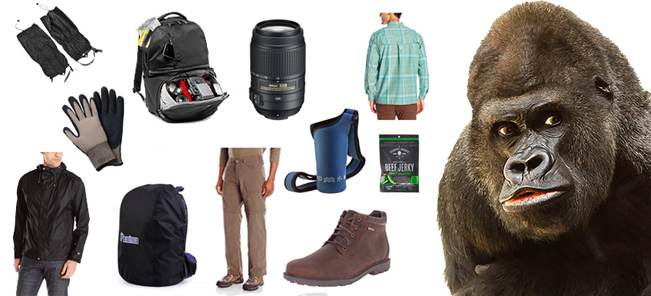
  • Long-sleeved shirt and trousers in dark, natural colors, no bright colors
  • Waterproof hiking boots and gardening gloves for steep, muddy sections
  • Rain jacket regardless of season Rushaga’s forest is unpredictable
  • 2+ liters of water, snacks, and a packed lunch (GHE days run long)
  • High-ISO capable camera; no flash photography is permitted near the gorillas

What Rushaga Guides Won’t Always Tell You

  • A GHE slot with Bikyingi doesn’t guarantee a close, calm encounter; semi-habituated gorillas can be shy, distant, or move off entirely; the four hours is a ceiling on time, not a promise of proximity.
  • The dominant silverback’s identity used in marketing material can outlive an individual leadership change. Always confirm who currently leads the family with your operator or UWA before travel, rather than assuming the name on a webpage is current.
  • Because Rushaga has the highest family count in Bwindi, it’s also the sector where last-minute permits are easiest to find, which occasionally means uncertain travellers are defaulted into Bikyingi’s GHE slot without a clear explanation that it costs nearly double a standard trek. Always confirm exactly which product (GHE vs standard) you are booking.
  • “Rushaga sector” in marketing copy describes an administrative area, not walking distance to the gorillas. Because Bikyingi’s range extends toward the DRC border, some habituation mornings involve an hour or more of vehicle transfer to the actual trailhead before the hike begins.
  • GHE visitors, unlike standard trekkers, are more likely to witness genuine stress responses in the gorillas vocalizing, retreating, or ignoring the group entirely. This is a normal, expected part of the habituation process, not a sign that anything has gone wrong with your visit.
Free Quote · A few Minutes Reply

Ready to See the Gorillas Yourself?

Tell us your dates and we’ll check live permit availability today: budget to luxury, Uganda, Rwanda & Congo.

Plan My Trek →

Frequently Asked Questions About the Bikyingi Gorilla Family

Where is the Bikyingi gorilla family located?

The Bikyingi gorilla family lives in the Rushaga sector, in the southern part of Bwindi Impenetrable National Park in southwestern Uganda. Rushaga is roughly 4 to 5 hours by road from Kigali via the Cyanika border crossing, or about 8 to 9 hours from Entebbe by road, with a faster ~1.5-hour flight option into Kisoro airstrip.

How many gorillas are in the Bikyingi family?

Reported figures vary between roughly 15 and 21 individuals, typically including 1 dominant silverback, several adult females, sub-adults, juveniles, and infants. Group size shifts constantly through births, deaths, and members transferring between families, so confirm the current count with your operator close to your travel date rather than relying on any single published figure, including this one.

Is the Bikyingi family open for standard gorilla trekking, or only the Habituation Experience?

Bikyingi is currently gazetted as one of only two Ugandan families eligible for the four-hour Gorilla Habituation Experience, alongside Bushaho in the Nkuringo sector. Most visits to Bikyingi are therefore the Gorilla Habituation Experience rather than a standard one-hour trek.

How much does it cost to see the Bikyingi gorilla family?

A Gorilla Habituation Experience permit for Bikyingi costs USD 1,500 per person, capped at 4 visitors per day. This sits well above Uganda’s standard USD 800 gorilla trekking permit, which applies to fully habituated, one-hour family visits elsewhere in Bwindi and Mgahinga.

What is the gorilla habituation experience, and how is it different from a standard trek?

The Gorilla Habituation Experience (GHE) allows up to 4 visitors to spend up to 4 hours with a semi-habituated gorilla family alongside active UWA researchers, compared with 8 visitors and 1 hour on a standard trek with a fully habituated family. GHE is exclusive to Uganda’s Rushaga sector and is not offered in Rwanda or DR Congo.

How did the Bikyingi family form?

The family formed in early 2012, when several individuals broke away from the disintegrating Mishaya gorilla group and combined with wild, previously unhabituated gorillas near a place known locally as Bikyingi, close to Rushaga. It takes its name from that location and from its dominant silverback.

Who is the silverback leading the Bikyingi family?

The group’s founding and long-reported silverback is named Bikyingi (also spelled Bikingi), described by rangers as unusually gentle and patient with the family’s infants.

How difficult is trekking to find the Bikyingi family?

The Rushaga sector overall rates as moderate to strenuous, and Bikyingi sits toward the harder end because its territory extends toward the Uganda–DRC border. Hiking time to first contact can run from under an hour to more than five, and Gorilla Habituation Experience days in particular should be budgeted as a full day rather than a half-day activity.

How do I book a gorilla habituation permit for the Bikyingi family?

Permits are sold by the Uganda Wildlife Authority, but most travelers book through a registered tour operator, since a permit alone does not include transport, ranger-briefing logistics, or cross-border coordination from Kigali. We recommend booking a gorilla habituation slot at least 4 to 6 months ahead of peak season, given only two families nationwide are eligible for the product.

What is the best time of year to visit the Bikyingi family?

The dry-season windows of June to September and December to February offer firmer trails and typically better visibility, though gorilla trekking runs year-round, and permits can be easier to secure in the quieter rainy months. Given Gorilla Habituation Experience’s limited daily slots, booking early matters more than chasing a specific season.

Where can I stay near the Bikyingi family in Rushaga?

Rushaga’s lodge options range from budget camps to properties such as Ichumbi Gorilla Lodge and Rushaga Gorilla Haven at the higher end.

What should I pack for a Bikyingi Habituation Experience visit?

Pack a long-sleeved shirt and trousers in dark, natural colors, waterproof hiking boots, gardening gloves, a rain jacket, at least 2 liters of water, snacks, and a packed lunch since GHE days run longer than standard treks, a high-ISO-capable camera (no flash allowed), and consider hiring a porter for USD 15 to 20 per day.

Free Quote · A few Minutes Reply

Ready to See the Gorillas Yourself?

Tell us your dates and we’ll check live permit availability today: budget to luxury, Uganda, Rwanda & Congo.

Plan My Trek →

Plan Your Bikyingi Trek

Whether you’re set on the four-hour Habituation Experience with Bikyingi or want us to talk you through whether a standard Rushaga trek makes more sense for your trip, we book these permits directly and can tell you what’s actually available on your dates. Tell us your dates, and we’ll check live permit availability within a few minutes: message us on WhatsApp or email info@trekgorillas.com.